AACSB 2020 → 2026: What Really Changed in the Standards?
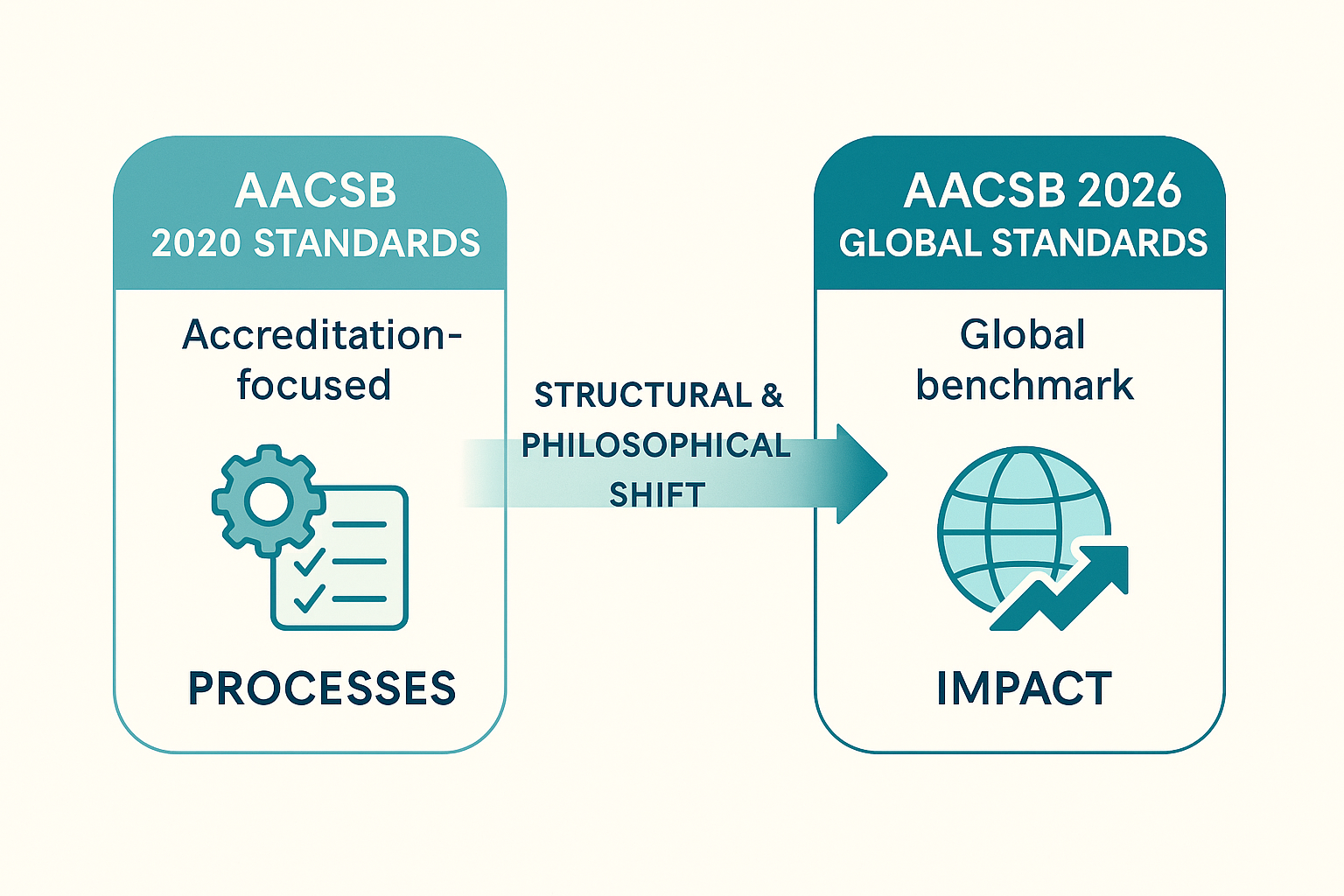
AACSB’s 2026 standards are not a simple update of the 2020 framework. They represent a structural and philosophical evolution in how quality in business education is defined and assessed.
From accreditation standards to global standards
The most significant change lies in the scope and purpose of the standards.
In 2020, the Guiding Principles and Standards for Business Accreditation were explicitly designed for AACSB-accredited schools and those seeking accreditation. In 2026, AACSB introduces the Global Standards for Business Education, intended to serve as a global benchmark for all business schools, regardless of accreditation status. Accreditation is now presented as a formal recognition of alignment with these global standards, rather than the standards themselves.
AACSB explicitly states that, with this new framework, it expands its role from accreditor to global standard setter
A clearer separation between standards and accreditation
The 2026 document clearly distinguishes:
- the Global Standards, which articulate what high-quality business education looks like worldwide; and
- AACSB accreditation, which defines the processes, evidence, and peer review mechanisms used to assess alignment.
This separation was far less explicit in the 2020 standards, where accreditation logic, guiding principles, and standards were tightly interwoven.
A stronger focus on outcomes and impact
Impact was already present in the 2020 standards, but the 2026 framework makes it central and explicit.
The emphasis shifts clearly from:
- the existence of processes,
to - the difference those processes make.
This is particularly visible in three areas:
- Teaching effectiveness
Teaching is no longer treated as implicit or assumed. It becomes:
- an explicit requirement for all faculty categories, including Scholarly Academics (SA); and
- a measurable dimension, reinforced by a mandatory student survey on teaching effectiveness during the self-study year (Standard 7).
- Assurance of Learning
The requirement to demonstrate “closing the loop” is no longer narrative only.
Table 5-1 becomes mandatory, requiring schools to explicitly document:
- first measurement,
- problem identification,
- curricular intervention, and
- second measurement.
The loop is only considered closed after the second measurement.
- Societal impact
Societal impact is consolidated into Standard 9, with:
- a mandatory reporting table (Table 9-1), and
- increased flexibility allowing schools to select different focus areas for curriculum, scholarship, and engagement, rather than forcing a single transversal theme.
What changed in the standards
- Strategic planning (Standard 1) now explicitly requires a formal connection between the business school strategy and the university strategy, with consolidated risk analysis.
- Resources (Standard 2) now refer to physical, digital, and financial resources, replacing the narrower notion of “virtual” resources.
- Faculty qualifications (Standard 3) undergo the most significant revision:
- the 2×2 SA/PA/SP/IP matrix is replaced by a three-part qualification framework (Initial Qualifications, Maintenance, Engagement);
- teaching effectiveness is elevated as a core requirement for all faculty categories;
- Practice Academics (PA) now require a master’s degree, not a terminal degree;
- Instructional Practitioners are renamed Instructional Academics (IA).
What did not change fundamentally
- The nine-standard architecture remains.
- Schools retain significant autonomy to define:
- teaching effectiveness criteria,
- faculty engagement expectations, and
- impact focus areas,
through shared governance.
- AACSB does not mandate generative AI proficiency; it is addressed under broader expectations of digital agility and ethical technology use.
In short
The 2026 AACSB standards do not break with the 2020 framework. They reframe it. The expectations are less prescriptive, more evaluative, and more strongly oriented toward demonstrated impact. For schools, the key question increasingly becomes not whether processes exist, but what difference they make — and how that difference can be evidenced.

Mélanie Cadart
Director - HEADway Q&A